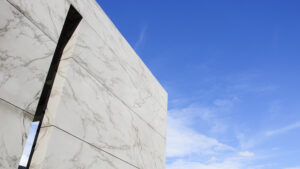
Porcelain slab installation is the process of fabricating and installing large-format porcelain panels for countertops, shower walls, fireplaces, feature walls, and outdoor kitchens. Because these panels can measure up to 63″ x 126″ (160 x 320 cm), they require specialized tools, experienced installers, and careful planning to ensure a successful installation.
At Luz Concept 5, we’ve seen that the most successful porcelain slab projects begin long before installation. Careful material selection, templating, and thoughtful fabrication help reduce installation challenges and create better finished results. Working alongside homeowners, custom builders, architects, and interior designers, we manage the technical complexities of these materials so that your design translates perfectly into your space.
Why Homeowners Choose Porcelain Slabs
Porcelain slabs have become highly sought after for residential interiors and outdoor living spaces because they solve many of the maintenance issues common to natural stone.
-
No Sealing Required: Unlike marble, granite, or quartzite, porcelain is non-porous. It does not require topical sealers or chemical deep-cleaners to protect it from water, oils, or food stains.
-
UV Stable & Weatherproof: Because porcelain consists purely of natural minerals without petroleum-based resins, it will not fade, yellow, or warp in the intense Florida sun.
-
Fewer Grout Joints: The massive panel sizes replace standard tile grids with large, continuous surfaces, drastically reducing visual clutter and cutting down on bathroom mold risks.
-
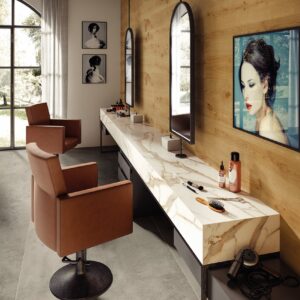
Versatile Aesthetics: Advanced manufacturing allows porcelain to replicate luxury marble, raw concrete, industrial metal, or limestone finishes with exceptional fidelity.
Where Can Porcelain Slabs Be Installed?
Kitchen Countertops & Backsplashes
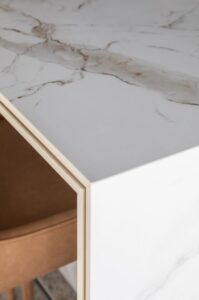
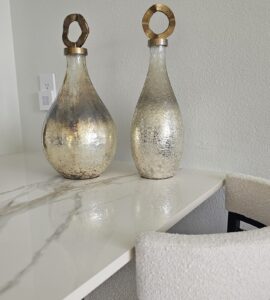
Porcelain countertops are highly durable choices for modern kitchens. Most structural countertop installations utilize 12mm or 20mm thick slabs, which provide excellent impact resistance. We regularly fabricate and install seamless porcelain countertops, matching backsplashes, and mitered waterfall islands for homeowners and builders throughout Sarasota, Lakewood Ranch, and Bradenton. We work with premium materials from leading international manufacturers, including Infinity Surfaces, Atlas Plan, SapienStone, Laminam, and Florim.
Fireplace Surrounds
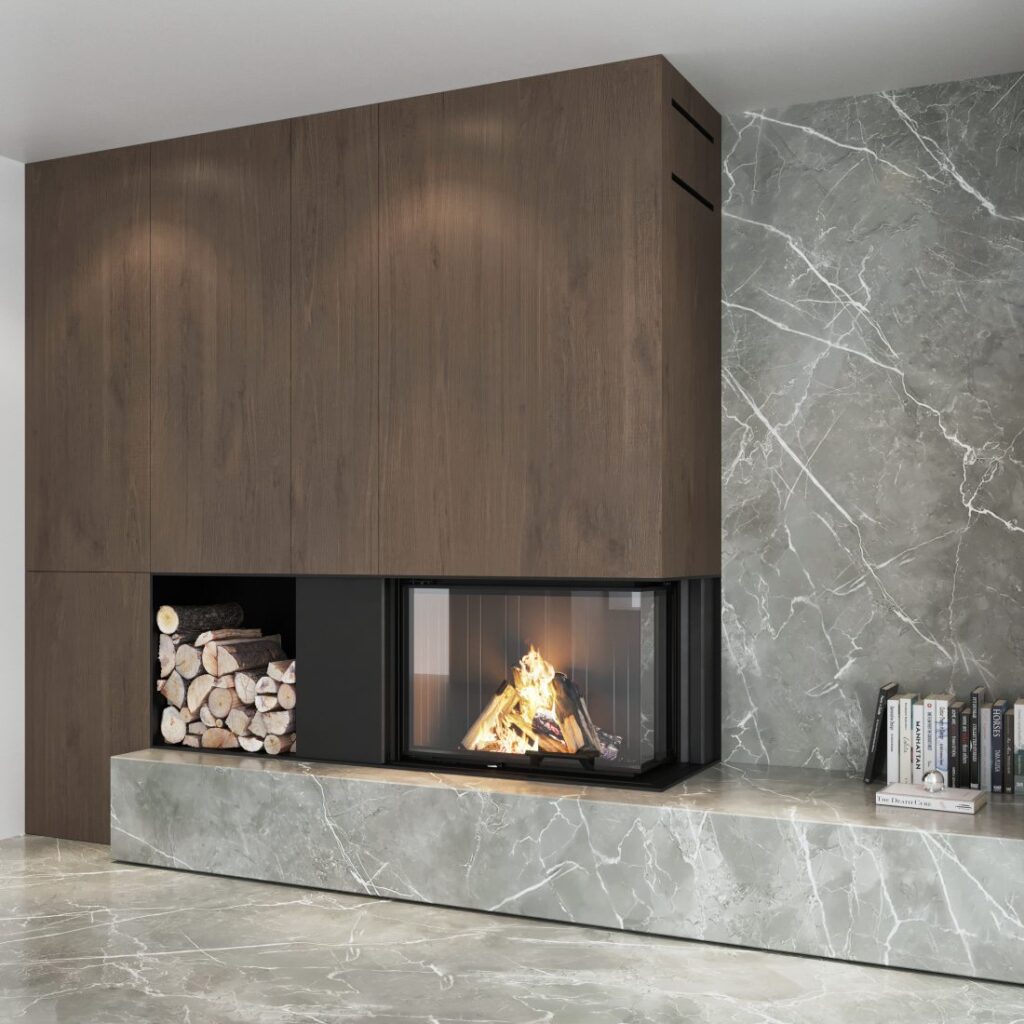
Porcelain is entirely non-combustible, making it a popular choice for modern fireplace surrounds. Because it can withstand high thermal shifts without cracking, we install floor-to-ceiling panels over linear fireplaces. This brings a clean, continuous stone look to living spaces in Venice and Nokomis without the heavy structural wall reinforcement required by thick natural granite or quartzite blocks.
Shower Walls & Bathroom Vanities
For bathroom remodels in communities like Osprey and Longboat Key, we frequently install 6mm porcelain slabs on shower walls. We also fabricate integrated porcelain vanities for homeowners and builders throughout Southwest Florida, where the sink basin is constructed out of the exact same slab as the countertop for a minimalist, monolithic appearance.
Outdoor Kitchens & Pools
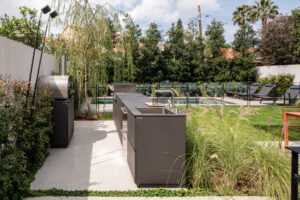
An outdoor porcelain kitchen or pool surround is highly stable in the intense Florida sun. It resists saltwater air, chlorine, heavy rain, and thermal shock from built-in grills without fading, warping, or requiring annual topical sealers. We provide these outdoor fabrications regularly for residential projects in Siesta Key, Anna Maria Island, and Naples.
Common Mistakes During Porcelain Slab Installation
Because large-format panels are highly rigid, installation mistakes can lead to irreversible damage. Awareness of these common installation pitfalls can help ensure your project runs smoothly:
-
Using Inadequate Handling Equipment: Attempting to lift or carry a 10-foot slab by hand without a rigid vacuum-suction stabilization frame causes the material to flex, leading to invisible micro-cracks that can split open later.
-
Improper Substrate Preparation: Installing slabs over uneven cabinetry or bowing drywall creates hollow voids. If a heavy object is placed over a void, the lack of support can cause the porcelain slab to crack.
-
Incorrect Mortar Troweling: Applying mortar in random swirls or circular patterns traps air pockets under the slab. Mortar must be combed in straight, parallel lines so that air can escape when the slab is embedded.
-
Neglecting Edge Easing: Leaving a freshly cut countertop edge perfectly sharp at a 90-degree angle makes it highly vulnerable to chipping. Edges should be finished with a subtle radius bevel or an eased profile to help distribute impact forces safely.
Free Resource: The Fabricator & Installer Inspection Guide
Avoid costly installation mistakes. We’ve put together a comprehensive checklist of questions, technical requirements, and red flags to watch for when hiring a professional for your project.
👉 Download the Free Guide: How to Find and Choose a Qualified Porcelain Fabricator
Frequently Asked Questions
Can porcelain slabs be used for full-height kitchen backsplashes?
Yes. Porcelain slabs make excellent full-height backsplashes because they create a continuous, grout-free wall surface behind cooktops. Since grease, oils, and pasta sauces cannot penetrate the vitrified surface, cleanup requires nothing more than a quick wipe with mild soap and water.
What is the difference between porcelain slabs and porcelain tile?
The primary differences come down to material size, density, and the level of engineering knowledge required for installation.
-
Porcelain Tile: Typically smaller, thicker relative to its surface area, and inherently more forgiving. Because tiles are set with frequent grout joints every few inches, those joints naturally absorb minor substrate imperfections and building movement.
-
Porcelain Slabs: Massive, continuous panels (often over 10 feet long) that eliminate grout lines but require immense technical knowledge to install successfully. Working with slabs is an engineering challenge: you must understand how to manage internal material tension during cuts, how to calculate strict substrate deflection limits, and how to achieve 100% mortar transfer to prevent hollow points. A standard tile setter relies on traditional layout lines, while a porcelain slab installer must understand structural physics, material stress points, and advanced slab mechanics.
Can porcelain slabs be book-matched?
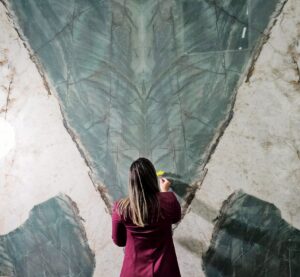
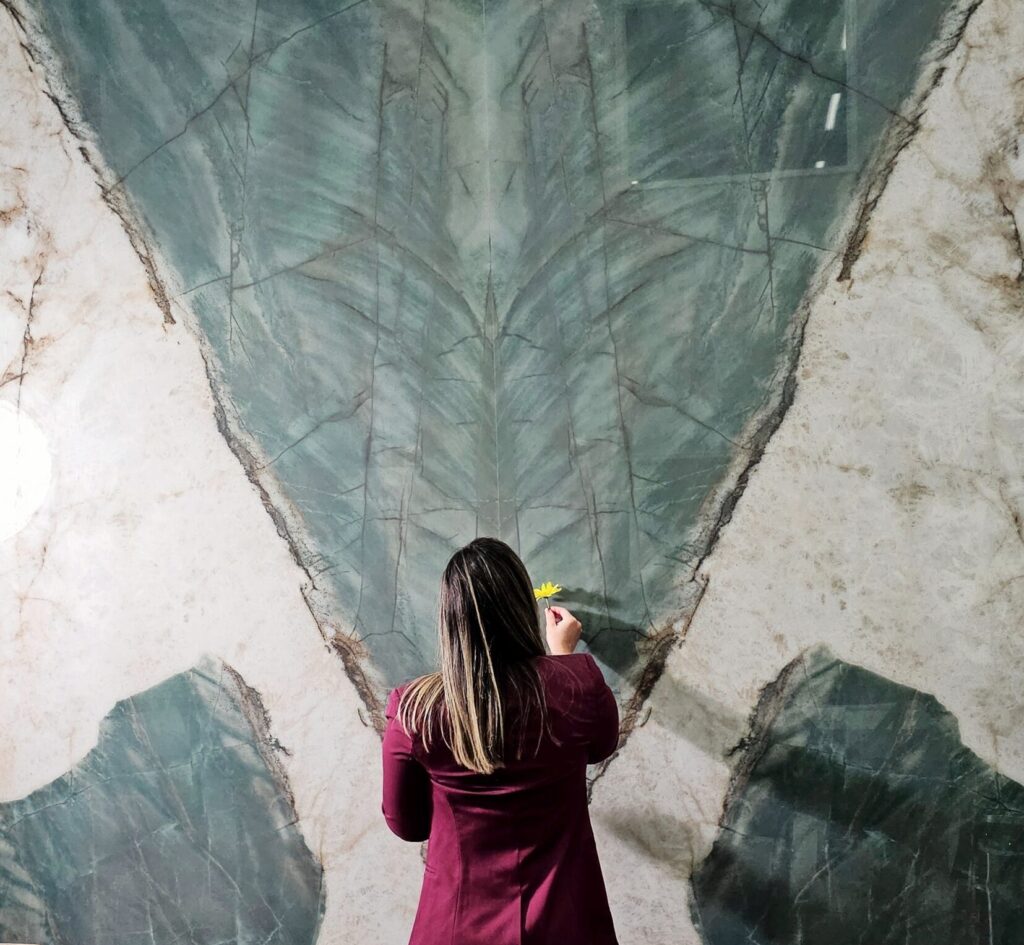
Yes. Many manufacturers produce slabs in mirrored “A” and “B” patterns. When installed side-by-side on feature walls, large shower enclosures, or waterfall islands, the veining aligns perfectly down the center seam to create a striking, symmetrical mirror image.
Are porcelain slabs suitable for fireplace surrounds?
Absolutely. Porcelain is entirely non-combustible and can withstand high thermal shifts without cracking, scorching, or off-gassing. This allows us to safely install floor-to-ceiling panels directly over modern linear gas or electric fireplaces, giving you a continuous stone look without the immense structural weight of solid quartz or granite.
Can porcelain slabs be used around pools and outdoor spaces?
Yes. Because porcelain is completely frost-proof, chlorine-resistant, saltwater-stable, and non-porous, it performs exceptionally well on outdoor pool copings, water features, and surrounding patios. It won’t develop mold or erode from pool chemicals.
What edge profile is best for porcelain countertops?
There is no single best edge because it depends entirely on your design aesthetic, your lifestyle, and how you use your kitchen.
Because this choice balances both style and everyday functionality, it is important to speak with an expert before deciding. Lais Luz can evaluate your project plans to help you select the right fit for your lifestyle. To explore your options, read our detailed Porcelain Edge Guide.
Have a porcelain slab project coming up?
If you have a client considering porcelain slabs, or simply want a trusted installation partner for future projects. We’d love to connect.
Contact Lais Luz to discuss your next project.
Let’s build exceptional spaces together.
Professional Surface Guides & Design Resources
-
Edge Engineering: Review our deep dives on the Mitered Edge Guide and the Eased Edge Guide to select the safest and most aesthetic profile for your countertops.
-
Surface Texture Analysis: Read our technical breakdown on choosing between Polished vs. Satin Finishes for high-traffic zones.
-
Advanced Appliance Integration: Learn about seamless hidden cooking technology in our dedicated Invisacook Installation Guide.